Basicrum opens its public beta

We are happy to announce that Basicrum is now open for a free public beta. Participants will receive four months of free access to our hosted Basicrum service.
We are starting with battle-tested integrations for WordPress/WooCommerce and Magento 1/OpenMage, while putting the finishing touches on our Magento 2 integration.


Our infrastructure is hosted in the European Union, and our integrations are built with GDPR compliance in mind.
Over the past year, we worked with several companies in a closed alpha. Their feedback helped us improve the product, fix bugs, and better understand the needs of Basicrum users.
Here is how Basicrum developed during the closed alpha.
The community
Building useful features depends on understanding what customers need. Over the past year, we spoke with web performance enthusiasts at Performance.now() in the Netherlands and at Magento Unconference events in the Netherlands and Germany. We also reached out to practitioners on LinkedIn and other social platforms.
At Magento Unconference Netherlands, Jeroen Boersma helped implement Content Security Policy (CSP) support in our Magento 2 extension.
After the conference, Jisse Reitsma from Loki Checkout and Ruud van Zuidam from Siteation.dev contributed to our Magento 2 extension.
Kostadin Bashev from Webcode helped us battle-test our Magento 1 module. He tested the module on a high-traffic but well-optimized store. Even though the store was well-optimized, Basicrum helped us identify performance bottlenecks in some of the key pages.
Jeroen Vermeulen from DeoVero BV needed Basicrum to support a high-traffic online store with thousands of monthly visits. We performed a load test that simulated traffic equivalent to more than one million visits per month.
The current feature set
Basicrum provides dashboards and widgets that help customers spot and troubleshoot Core Web Vitals problems.
The overview shows week-by-week trends for LCP, INP, and CLS. Its histogram widgets show the distribution of each metric, making it easier to see how experiences vary across visits.
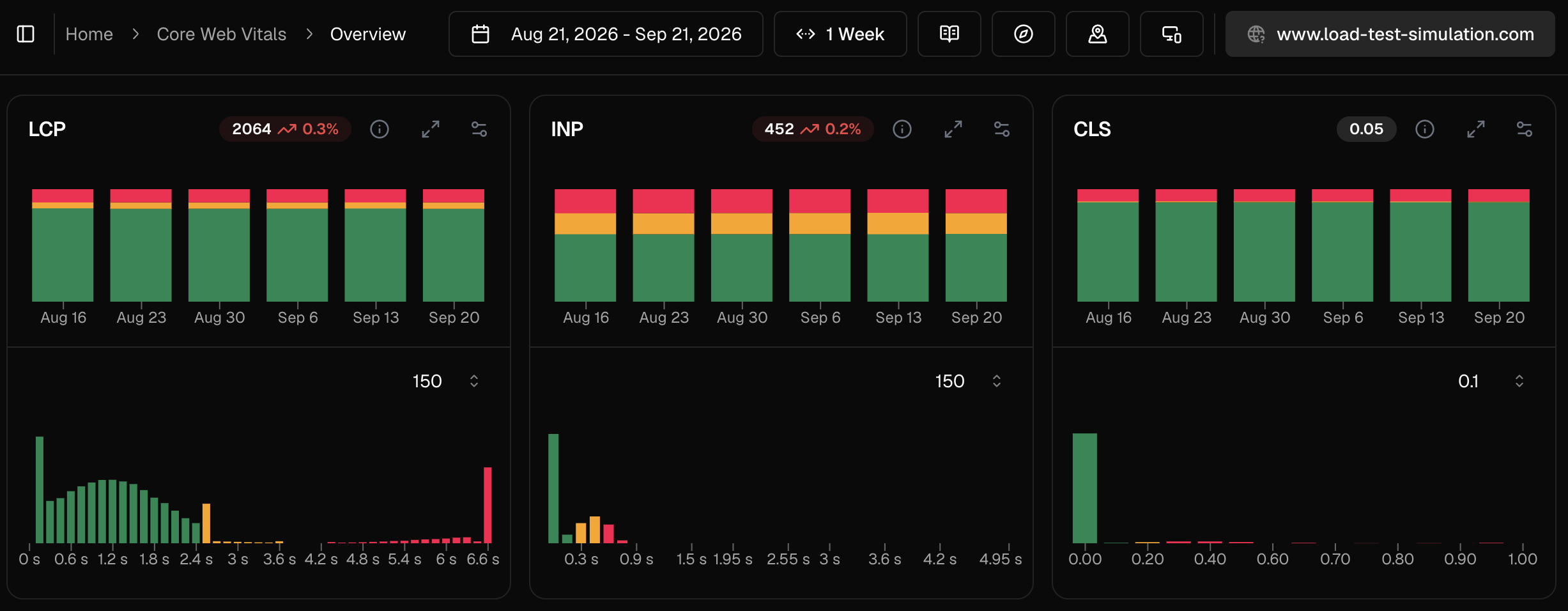
Basicrum users can also examine each Core Web Vitals metric in more detail and find signals that may point to the causes of a poor score.
On the INP dashboard, for example, Basicrum can highlight that an interaction with button#increment-quantity on the /en/customer/account/address-book page may be contributing to a poor score.

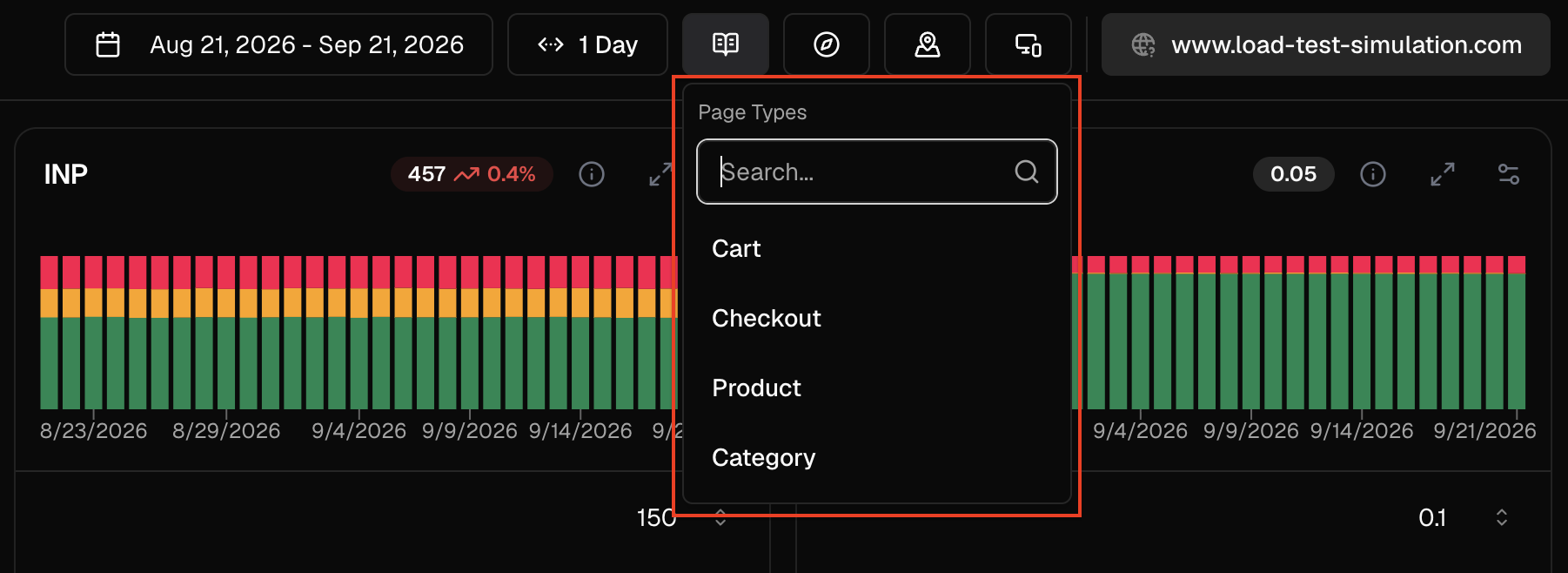
At launch, Basicrum includes the essential filters needed to drill down into performance data:
- Page type
- Browser
- Country
- Device type
The WordPress and Magento communities most frequently requested the page type filter. It helps users group data by page layout and identify layouts with web performance issues.
What comes next?
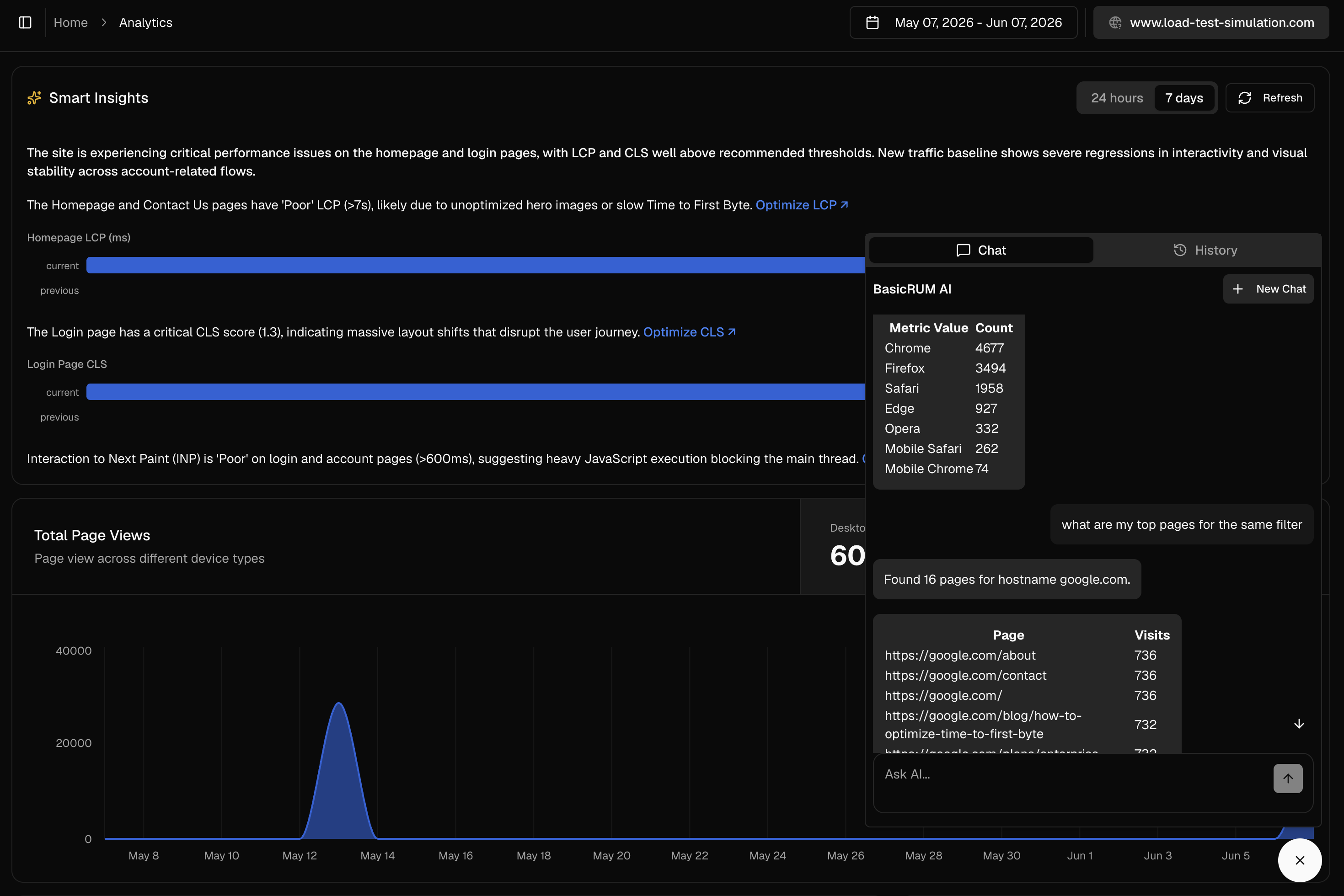
We have built a prototype AI assistant and will continue developing it during the public beta.
We will also work on:
- Statistics for resource type, size, and origin (first-party or third-party).
- Filters and statistics for navigation types, including prerender, back/forward, and reload.
- Filters and statistics for Long Animation Frames (LoAF), helping users identify the tasks and scripts that affect INP.
Throughout the beta, we will ask participants which features would make Basicrum more useful to them.